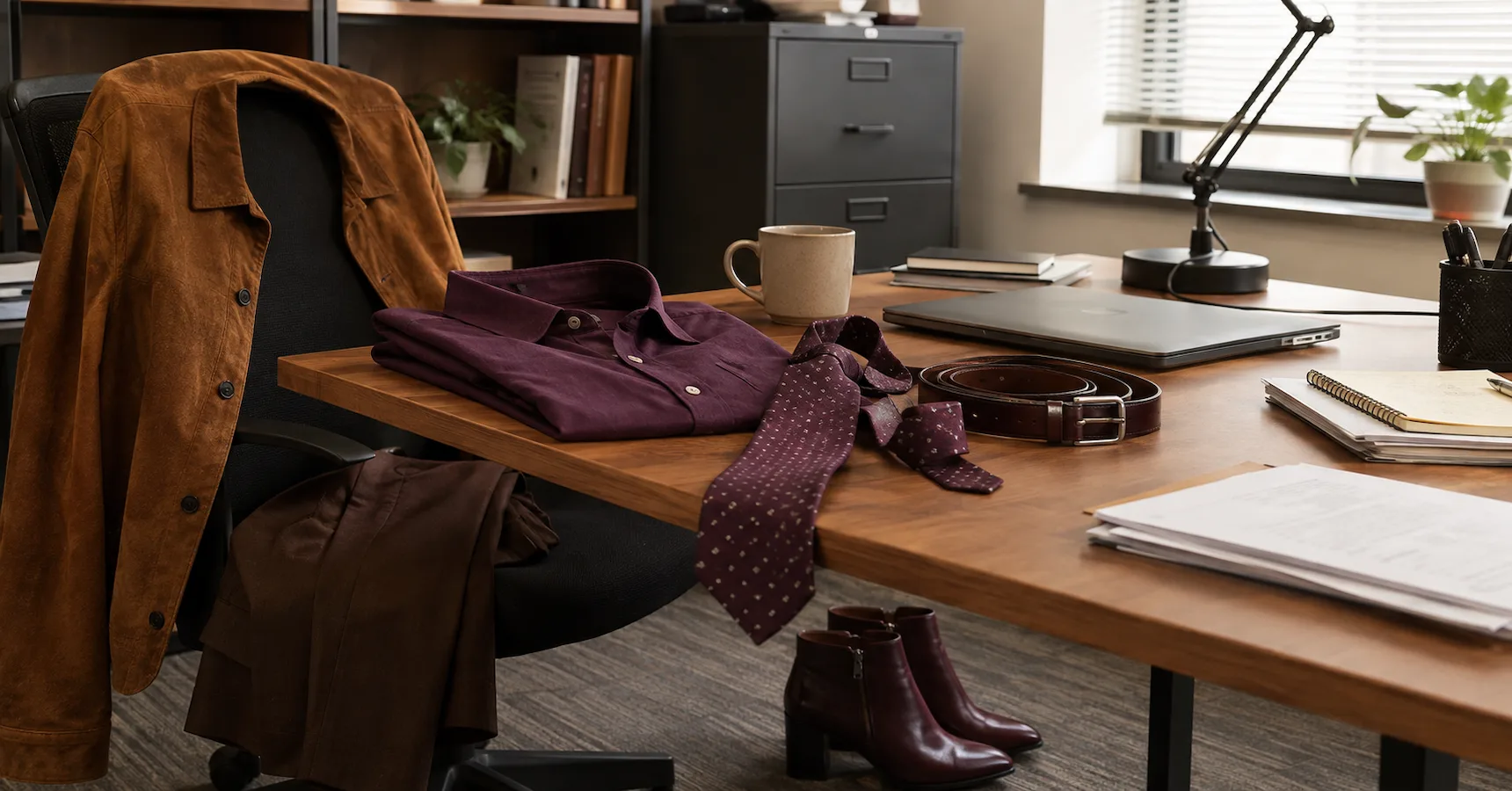
By half past two, most office clothes have been through more testing than they ever receive in a fitting room.
The waistband has spent hours folded at the hip. The back of the shirt has been against a chair back. Sleeves have crossed a desk several hundred times. The shoes have done the commute, and anything too warm has discovered what office heating thinks of personal ambition.
There is another problem peculiar to desk jobs. For most of the working day, nobody can see most of what you are wearing.
The desk has edited the outfit for you.
Your trousers disappear somewhere around the waist. Your shoes cease to exist until you stand up. The jacket has usually been left elsewhere. What remains is a much tighter composition: face, collar, shoulders, sleeves and hands.
If I want an outfit to look like mine at work, that is the part I start with.
Dress for the part the desk leaves visible
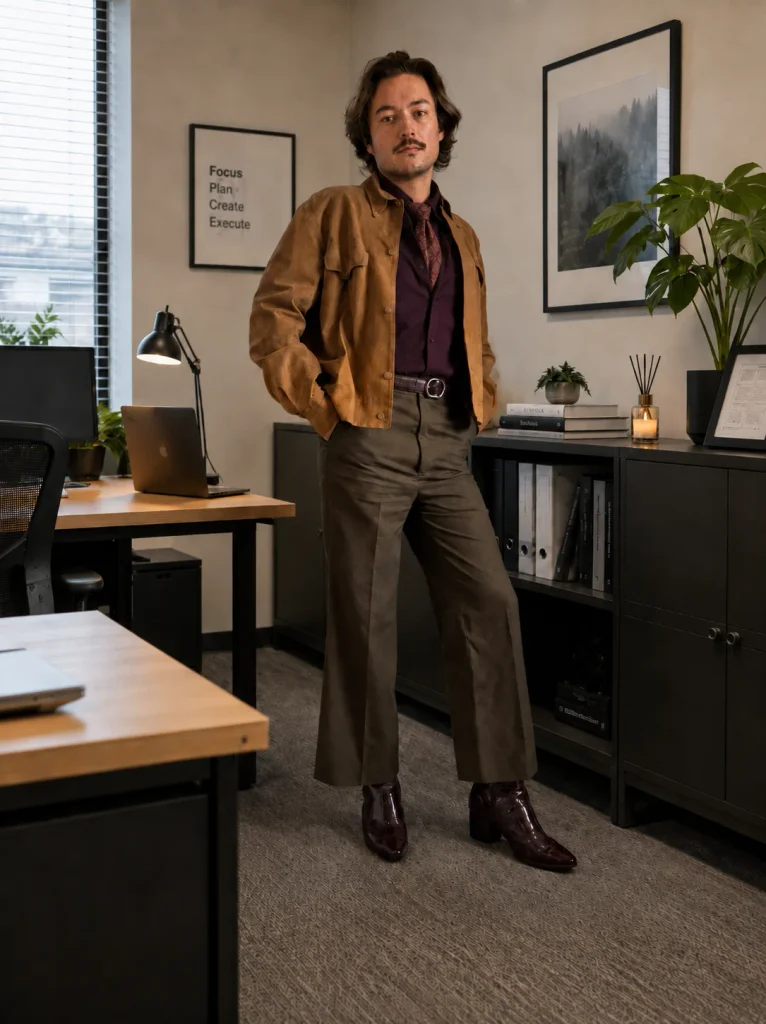
The outfit I wore while working on this article makes the problem fairly obvious.
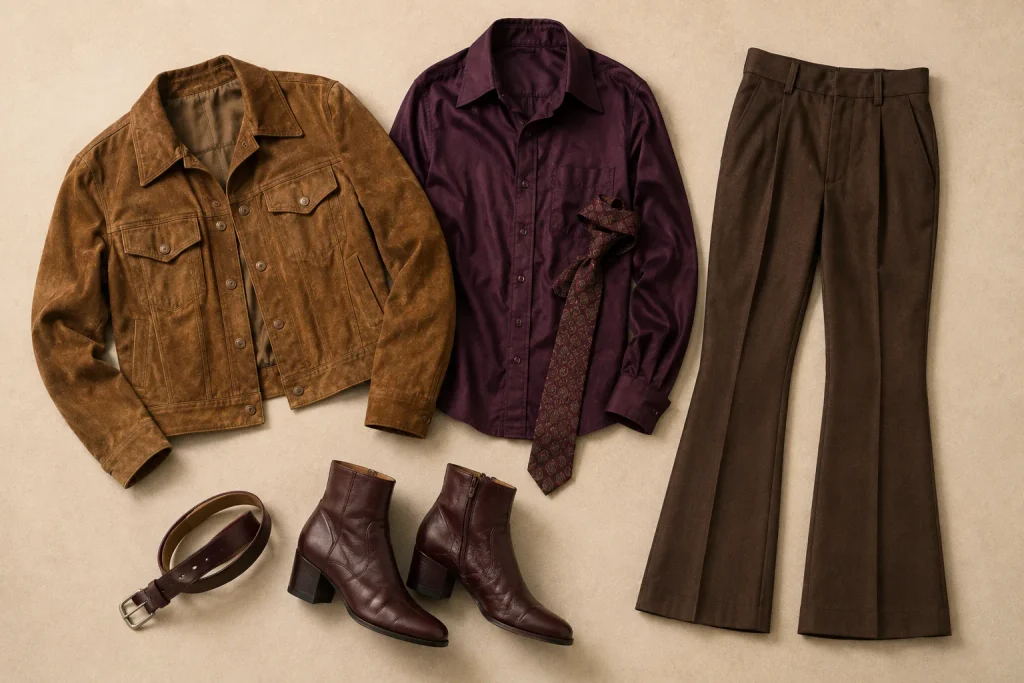
Standing up, I had on high-waisted chocolate-brown trousers with a wide, slightly flared leg, burgundy heeled boots, a matching dark belt, a deep plum shirt, a patterned dark tie worn loose beneath the open collar and a short tan suede jacket.
There is an obvious 1970s slant to it. The high waist, flare, heeled boots and short jacket all push the proportions in that direction without requiring me to dress as though I am about to be introduced by a BBC continuity announcer.
The shape matters as much as the colour. The jacket finishes around the waistband instead of swallowing the trouser rise. The trousers carry most of the weight through the lower half, then the boots give the hem a sharper finish. Plum, burgundy, chocolate and tan sit in the same warm territory without becoming one enormous brown object.
Then I sit down.
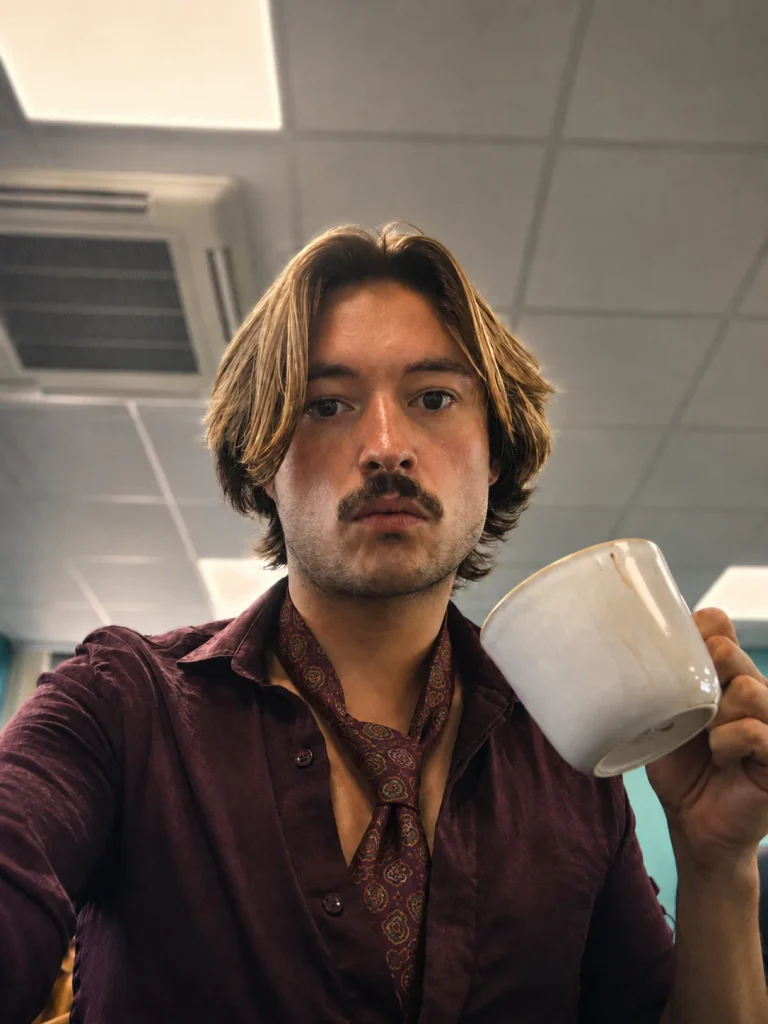
Almost all of it has gone. The boots are under the desk, along with the belt and most of the trousers. I have taken the suede jacket off.
What survives is the plum shirt, the patterned tie, my face, my hands and an enormous mug.
That is a different composition.
The collar itself is not especially dramatic. What changes it is the way I wear it: several buttons open, with the tie sitting loose underneath rather than pulled neatly up to the neck. The soft points fall away from the neck and create a much longer line down the chest.
I would happily replace the shirt with one in exactly the same plum but with a properly extravagant 1970s-style long-point collar. If the desk is going to leave the collar visible all day, I may as well give it a better one.
The tie helps because it continues that downward line while adding a small amount of pattern close to the face. Worn beneath the open shirt, it loses much of the corporate neatness of a tie fastened correctly at the neck. I still get the colour and shape without looking as though somebody has summoned me to explain a disappointing quarter.
A tie is only one way of using the part of an outfit that remains visible. A scarf, brooch, necklace, glasses, distinctive cuffs or a textured piece of knitwear can occupy the same useful territory around the face and hands.
Texture can be more useful than simply adding another colour. Corduroy, brushed wool, ribbed knitwear or a shirt with a little sheen can still register under fairly grim office lighting, where subtle colours have a habit of becoming administrative grey.
The smaller visible area also makes clutter more obvious. If the collar, tie, glasses, rings and cuffs are all demanding attention in the same square foot, there is nowhere for any of them to retreat.
I would rather choose one or two things that survive sitting down particularly well.
Try the half-past-two test
Being able to sit down in something is a very low bar for office clothes.
The useful question is whether you still want to be wearing it several hours later.
I think of this as the half-past-two test.
By then, anything quietly irritating has usually declared itself. A waistband that seemed merely close at nine has become the thing you keep pulling away from yourself without noticing. A shirt has spent five hours escaping from the back of the trousers. A cuff catches against the desk whenever you reach for the mouse. A tie has developed an interest in your tea.
Nobody else may be looking at the trousers beneath the desk, but your hips are still in them.
I still use the ordinary movement test when buying clothes: sit down, reach forwards, use the pockets, move your arms and see what pulls. My guide to making second-hand clothes look expensive goes into that fitting-room test in more detail.
The half-past-two test begins where the fitting room stops.
My plum shirt, unfortunately, fails it.
The fit is closer through the body than I now prefer, and several hours sitting down make that considerably harder to ignore. Add lunch and the shirt begins behaving as though eating were an unauthorised alteration to the original design.
That alone is useful information. I like the shirt. I like the colour enormously. I like what the open collar and loose tie do in this particular outfit. None of that requires me to pretend it is comfortable enough for eight hours at a desk.
Comfort is only half of the test. The other question is what repeated office wear is doing to the cloth.
Desk work puts the same areas of a garment against chair backs, seats and desk edges again and again. With wool, repeated abrasion can contribute to pilling — the small balls of fibre that form on the surface — and Woolmark specifically includes long periods sitting at a desk among the situations where that rubbing can occur.
My shirt has stubborn bobbling of its own, even after a pass with a debobbler, although I cannot pin that on the office chair.
What I can do is look at the parts of my work clothes that repeatedly come into contact with something else: cuffs, elbows, the seat of trousers and anywhere the surface has begun to look rougher than the cloth around it.
It takes seconds when the clothes come off, and catching wear while it is still small is considerably more useful than discovering it six months later. My beginner’s clothing-care guide goes further into what to do afterwards.
The chocolate trousers pass the half-past-two test much more convincingly.
Standing up, the high waist and wider leg are one of the strongest parts of the outfit. Sitting down, their greatest achievement is leaving me alone.
If a pair of trousers spends eight hours making you aware of the waistband, their excellent pleats have failed to negotiate favourable terms.
Those same trousers later turned out to solve a completely different problem: giving a dramatic shirt enough weight below the waist.
Put the character where your dress code allows it
I have quite a lot of freedom where I work now. That suits me because I tend to dress smartly anyway, although my version of smart occasionally wanders into territory a stricter workplace might regard as unnecessary.
I have worked somewhere more conservative, and I dressed more conservatively there.
I did not regard employment as an elaborate test of whether I could defeat a dress code with a sufficiently suspicious shirt. The broad silhouette was more conventional, so the interesting decisions became smaller.
A restrictive dress code does not remove personal style. It reduces the acreage available for it.
A collar is particularly useful because it occupies almost no additional space and remains close to the face. A little more length, a better proportion against the layer above it or simply enough contrast to remain visible can alter what people actually see while leaving the rest of the outfit completely conventional.
Texture does something different. A ribbed knit or brushed cloth gives a plain colour depth, which is useful when navy, charcoal and brown are doing most of the permitted work. You are still inside the dress code; the surface is simply less dead.
Colour can move to smaller objects too. Oxblood rather than black shoes changes the outfit once you stand. A burgundy belt, patterned tie or darker plum shirt can carry the colour without demanding that every garment participate.
Fit becomes more important for the same reason. When the permitted clothes are conventional, where the waistband sits, where the jacket ends, how much collar remains visible and whether the shoulders actually belong to you become some of the strongest decisions left.
The practical part ends there. My own reason for bothering with any of it is considerably less profound.
I like being recognisable at work.
In a large organisation, it is remarkably easy to become somebody you vaguely remember seeing near a printer. I would rather be the one who is usually a little smarter, wears the wider trousers and appears to have stronger feelings about collars than the situation strictly demands.
There is no great professional philosophy behind this. I simply prefer it.
Fluorescent tailoring would make me memorable as well.
So would a fire alarm.
The useful distinction is whether I would still want to wear the clothes if nobody at work was going to remark on them.
At five o’clock, the rest of the outfit comes back
Eventually I stand up.
The trousers return. The boots become visible. The suede jacket goes back on. In colder weather, outerwear that has contributed absolutely nothing to the previous eight hours suddenly becomes the largest thing I am wearing.
My charcoal herringbone coat does exactly that. I paid £40 for it second-hand because the shoulders and upper back already fitted properly; the full inspection is in my guide to buying a second-hand wool coat.
An office outfit does not have one job.
The shirt and collar have to work from the other side of a desk. The trousers have to remain comfortable while most of them are invisible. The shoes still have a commute to do. Outerwear spends much of the working day absent and then takes over the moment you leave.
The half-past-two test tells me whether the clothes have survived the office.
Five o’clock tells me whether I still like the outfit when I get it back.
I spend too much of my week sitting at a desk to tolerate clothes that only work while I am standing attractively beside a mirror, and too much time choosing clothes I actually like to accept becoming anonymous from the chest upwards as soon as I sit down.
The desk can have most of the outfit.
It does not get all of it.
Leave a Reply