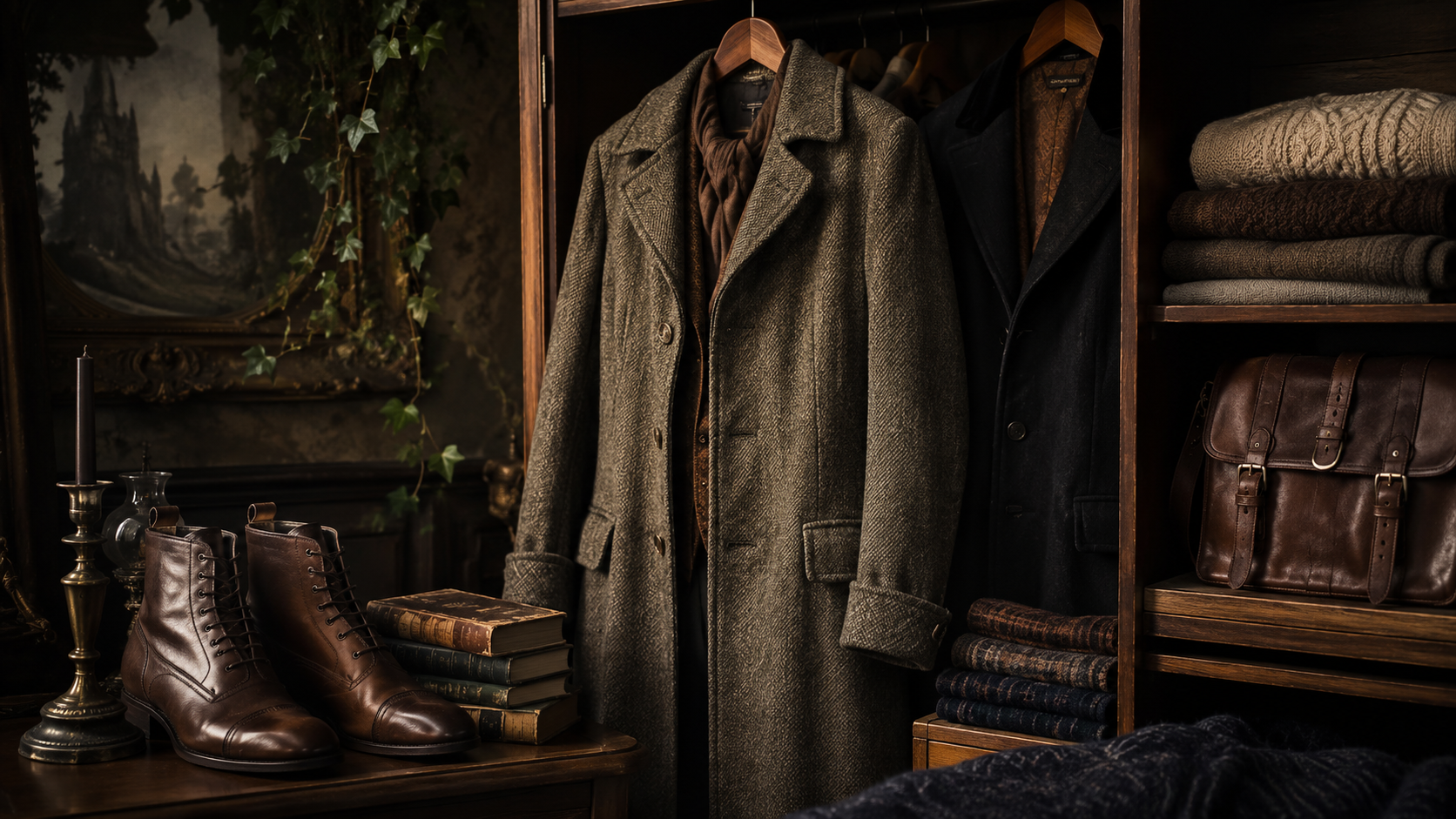
A storybook wardrobe is built by translation. Take the qualities you like in books and fantasy — movement, texture, severity, softness, age, romance, eccentricity — and find ordinary clothes that produce some of the same effect in real life.
That might mean a soft wool coat with the sweep you liked in a cloak, a battered leather satchel, polished boots, a heavy knit, a dramatic collar or a dark floral shirt. It might also mean completely ordinary clothes put together with unusually deliberate proportions, texture and colour.
The useful test is simple: would the outfit still make sense if nobody understood the reference?
If it would, you are building a wardrobe rather than assembling a costume.
Start with the quality you actually want
Characters and archetypes are useful starting points when you treat them as clues rather than shopping lists.
Suppose you like the idea of a scholar. A severe, orderly version might suggest a sharp collar, pressed trousers and dark leather. An absent-minded scholar might lead instead towards rumpled shirts, heavy knitwear and a bag that looks as though it has been put down on several library floors. Both belong to the same broad reference, but they produce very different wardrobes.
Do the same with gothic, romantic, pastoral or fantasy influences. Work out what is actually attracting you: severity, softness, movement, practicality, age, richness, eccentricity or something else. Once you can name the quality, you can look for clothes that create it without reproducing a fictional uniform.
The character gives you a problem to solve; your own clothes have to provide the answer.
I followed that problem through Jane Eyre’s clothes, where the useful distinction turned out not to be grey versus colour, but imposed plainness versus clothes Jane chose for herself.
I usually start with a book and work out what the clothes are trying to do. I’ve now built a quiz that reverses the process: make ten wardrobe choices and it will recommend the book your clothing instincts point towards.
Translate the reference into real clothes
Sometimes the translation is straightforward. If you like the sweep of a cloak, a long coat may give you the length and movement you wanted. An elaborate fantasy shirt might become an ordinary shirt with a larger collar, fuller sleeve or unusual cuff. Jewellery can carry the suggestion of a talisman without requiring anybody else to recognise the reference.
The useful question is what visual job the original piece was doing. Was it creating length, volume, severity, movement, texture or a focal point? Once you know that, you can reproduce the effect without hunting for the nearest modern imitation.
I used the same test more literally when I built a gothic Halloween party outfit from real clothes rather than a costume.
Second-hand clothing is particularly useful here because the garment arrives with evidence already on it. You can see where the cloth has rubbed, whether a knit has kept its shape, how leather has creased and whether the lining is beginning to fail before the outer fabric. Those signs tell you considerably more than an aesthetic label does.
Age is not a certificate of quality. It does, occasionally, leave useful evidence.
If you would rather begin with brands already working in that middle ground, I have since compared eight fantasy-inspired clothing brands whose current ranges try to make historical, folkloric or fantastical details behave as ordinary clothes.
Build the silhouette before the decoration
Before worrying about rings, scarves or whether the brown is sufficiently library-like, look at the shape of the clothes together. Silhouette is the overall outline an outfit makes: where the waist sits, how much width the trousers carry, where the coat finishes and how the volume of one garment relates to the next.
This matters particularly when one piece is dramatic. An oversized shirt, sweeping coat or full trouser leg needs enough visual company to look deliberate; surrounding it with the smallest, quietest pieces available can make the imbalance more obvious.
I ran into exactly that problem in my guide to how to wear a dramatic shirt without looking like costume. Fuller, high-waisted trousers balanced the volume of the shirt far better than the narrow dark pair I first tried.
Fit still gets the final vote. A beautiful coat whose shoulders already feel restrictive in the shop is not rescued by an excellent colour or a particularly literary air.
Choose cloth by how it behaves
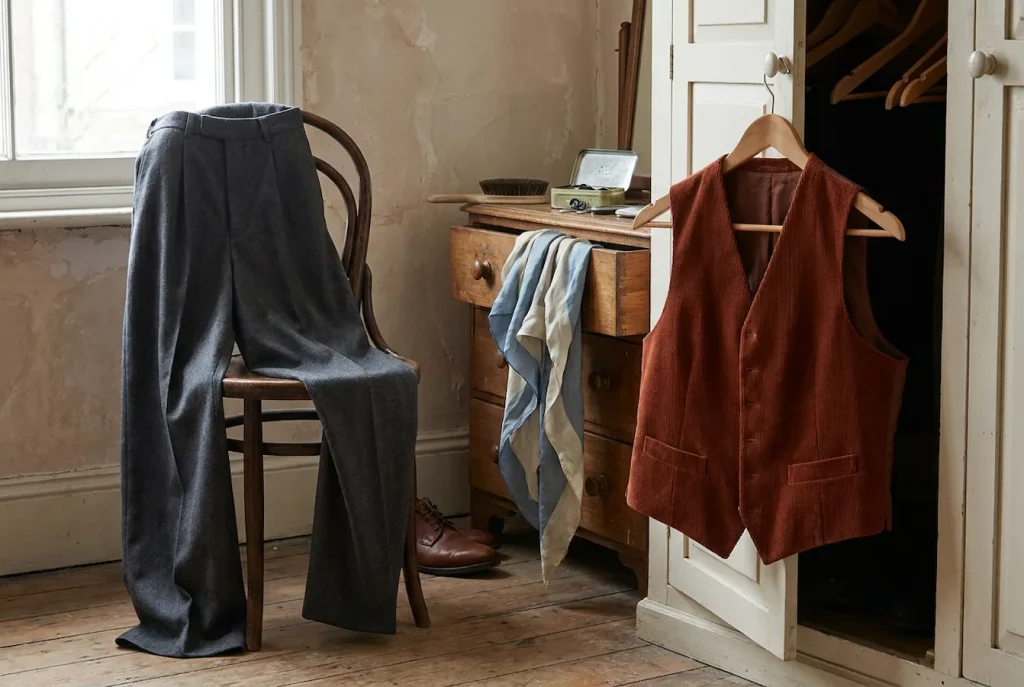
Texture matters, but a list of wool, velvet, corduroy, suede and linen only gets you so far. Pay attention to what the cloth actually does.
Drape is the way a fabric hangs and deforms under its own weight.
You can see the difference without measuring anything. A fluid shirt may fall in soft folds and move around the body, while a coat needs more body if you want it to hold a clean outline. The useful behaviour depends on the job the garment has to do.
That tells you more than deciding that velvet is automatically romantic or tweed automatically scholarly. A limp jacket remains limp however many old books are placed beside it for the photograph.
Texture then becomes part of the outfit itself. Corduroy trousers beside smooth leather shoes create a different effect from plain wool trousers with the same shoes; a brushed coat, soft shirt and polished leather can make a restrained palette feel much richer without requiring anything remotely theatrical.
Give the colours somewhere to belong
Colour can provide continuity even when the individual garments come from different periods, shops or departments.
Start by noticing the colours that already recur in the clothes you reach for most. If dark brown appears in your shoes, belt and favourite coat, or burgundy keeps turning up in shirts and knitwear, those repetitions are already doing useful work. New pieces do not have to match exactly; they need enough relationship to avoid looking as though each one arrived from a different wardrobe.
A restricted palette can make unusual textures and silhouettes easier to combine, but it does not have to mean muted colours. Bright green, cobalt, scarlet or anything else can belong perfectly well when it has some company elsewhere in the outfit.
You do not need to buy a palette into existence. Notice what is already there, then use those recurring colours as one of the tests when judging a new piece.
If dark academia is the direction you want to develop, my guide to dark academia outfits for real life takes that particular palette and turns it into complete outfits using ordinary clothes rather than costume pieces.
Let strong pieces agree with each other
Several distinctive pieces can work together when they share some logic. A large shirt and fuller trousers can agree through scale; embroidered boots and jewellery can share a similar degree of ornament; a strong colour can recur elsewhere without every item having to match.
An ornate shirt, substantial boots and a ring may already form a coherent outfit. Add a novelty buckle, an unrelated patterned scarf and several necklaces, and each new piece starts demanding its own focal point. Let a few visual ideas repeat rather than asking every accessory to invent another one.
Test it in the life you actually have
The mirror is a very forgiving place to build a wardrobe. Real life is less cooperative.
Sit down in the trousers. Put your usual coat over the shirt. Carry the bag you actually use. Walk far enough to find out whether the boots remain comfortable. If a sleeve only looks good while your arms are hanging straight down, try typing, reaching for something on a shelf or putting another layer over it.
Weather belongs in the test as well. A garment can be impractical in some ways and still deserve space because it is beautiful, pleasurable or simply makes getting dressed more interesting. The useful part is knowing which inconvenience you are choosing before you pay for it.
Clothes begin to feel like your wardrobe when they have to coexist with your actual commute, workplace, laundry, coat and weekend rather than the better-lit life imagined in the fitting room.
Look after what earns its place
Wear can add character; dirt, stretched knitwear and missing buttons merely hide it. Brush garments when their fibre and construction make brushing appropriate, polish leather with products suited to it, deal with stains promptly and repair loose buttons before they become missing ones.
Press or steam only where the care label and construction allow, and fold knitwear when hanging would let its own weight distort the shoulders. The aim is to preserve what you liked about the garment, not make every second-hand piece look newly manufactured.
A second-hand blazer can look far more expensive once fit, creasing and small maintenance jobs have been dealt with. My beginner’s guide to clothing care covers washing, stains, storage and basic repairs in more detail.
Let the wardrobe grow slowly
Start with what you already wear, notice the gaps, then become annoyingly selective.
Second-hand shopping helps because the stock refuses to cooperate with a shopping list. Some Saturdays will produce exactly the coat you did not know you were looking for. Others will produce six metres of beige polyester and a blazer whose sleeves appear to have been designed during a dispute.
Coming home empty-handed is a complete outcome. The point is to add clothes that work with one another and with your actual life, rather than buying an entire aesthetic in one weekend and discovering a month later that you only like the pieces when they are standing together.
A storybook wardrobe should feel collected because it was collected.
Build a wardrobe that belongs in your life
The fantasy reference can recede once the clothes are doing their job. You might end up with a long coat because you liked the movement of cloaks, fuller trousers because they balance the shirts you actually own, worn leather because you prefer its surface to something glossy and new, or a run of dark colours because they make getting dressed easier.
Nobody else needs the footnotes. The clothes have made it out of the story and into your life.